Showing posts with label student_work. Show all posts

Friday, October 23, 2009

Warrior Work 10-23-09

Some recent work from our students and teachers.

Michele asks:
In a complete paragraph, starting with a focused topic sentence, agree or disagree (or somewhere in the middle) with the following statement: The individual is more important than the group.
Greg wonders:
Who is more heroic: Jason or Perseus?
Who doesn�t want to know about:
A summary of ionic bonding and Lewis dot structures along with a summary of lattice energy.
Lary asks for Thematic Thesis Statements from Whale Rider.

Jesse asks for reactions to the cadaver lab.

What are you views on Censorship?
1. Is it okay to have books on making bombs in the school library?
2. Will banning books keep people from reading them?
3. Television shows are censored, so are song lyrics�what makes books different?
A little live blogging of a fishbowl discussion on Fahrenheit 451: Smith 2, Moritz 3,Moritz 4,Smith 5

Monday, October 19, 2009

This I Believe Goes Global - We Want You!

(This post is written by Anne Smith and cross-posted on Learning and Laptops. So the "I" in this post is referring to Anne.)

For the past three years, I have had my classes write their versions of National Public Radio�s �This I Believe� segment. I was introduced to this idea by a colleague and have been always impressed by what my students hold as their personal values and beliefs. Writing these essays has allowed for them to do something they don�t get to do all that often at school - express their heartfelt beliefs. After writing the essays the first year, we submitted them to NPR, but we also decided to podcast them ourselves � no need to wait to see if NPR might choose to broadcast them. The writing was good at expressing their values, but once their voice was added to their written expression, WOW, it simply transformed that personal essay. Instead of the words simply being words, the words conveyed deeply held emotions. Now, this is the standard.

Previous class examples:
Period 2 06-07
Period 5 06-07
Period 3 06-07
Period 2 07-08
Period 5 07-08
Period 3 07-08
Wiki 09-10

We are approaching that time of year, when I am going to start the kids on this writing adventure, but this year I wanted to invite you in the blog-o-sphere to join us again. I want �This I Believe� to go global. I want my students to benefit not only from knowing what their peers believe, or what the other AHS classes believe, but to hear and see what the world values. What do kids elsewhere in the U.S. believe in? What do kids elsewhere in the world believe in? What do some of the learned professionals that I know believe in? I want my students to walk away from this experience realizing the power they have as professional writers as well as connecting to other teenagers and adults from around the world. I want to see them exchange ideas, foster relationships, and appreciate the variety of perspectives. Maybe you can challenge your principal, your school board members, your local politicians, heck, maybe your entire school. Maybe we can even get our President to write his own �This I Believe.�

So, how do we accomplish this? Karl Fisch, of course, is willing to be my master facilitator. He has set up a wiki (still a work in progress) that will provide the guidelines for the classes to follow. I am making Maura Moritz�s classes join us again, so there will be four classes (ninth grade, 14 and 15 years old) from AHS writing and podcasting their essays: Moritz 3, Moritz 4, Smith 2, and Smith 5. We are hoping to attract at least three other classes from around the world, one each to pair up with each of our four classes. If we get more than four classes that are interested, then we will try to pair up any additional classes with another class somewhere in the world. If your class(es) are interested, please complete this Google Form with some basic information (your name, your email address, school name, location, grade level(s)/ages, how many classes, number of students in each class, and time frame that you�d like to do this) so we can setup those partnerships. (Our thinking is that pairing one class with one class will keep this from becoming too overwhelming for the students, although of course anyone can read/listen/comment to any of the essays on any of the wiki pages). We will create a wiki page for each set of paired classes and each student will upload their written essay as well as their podcast (the podcast can either be uploaded directly to the wiki, or you can use a variety of other services for that and then link to them). Each pair of classes will be in charge of their own wiki page and we�ll use the discussion tabs on each page to give feedback to the students. If you are an adult interested in writing a piece yourself, simply add them to the �adults� page on the wiki. I am hoping to get some notable edubloggers as well as my superintendent, CIO, and others to participate. It would also be helpful to include a brief bio so the kids can know who they are reading about. Obviously you don�t have to do this with us or on our wiki, you can create your own. But we thought it might be interesting and helpful to have one wiki that aggregated all these essays/podcasts, one place that students (and others) could visit to learn about beliefs all over the world.

Wondering where to start? NPR has a number of education friendly links to help you along the process:
For Educators
For Students
Essay writing tips
How to contribute an essay to NPR

Timeline: For our classes we are going to start writing our essays, November 6th with a final due date of November 13th for their essay. The following week they will begin podcasting their essays. The paired classes don�t have to match this timeline exactly (although that would be great), but we�re hoping they can have theirs completed by Thanksgiving so that the students can start commenting on each other�s essays/podcasts.But for other pairings you can set whatever time frame works best for you � that�s the beauty of the wiki, it�s a living document with no �end� to the assignment (although that�s why we need you to include your time frame when you email us so that we can try to match folks up). We would really appreciate any feedback (now or as this progresses) to make this an experience that is truly relevant and meaningful for these kids.

Tuesday, October 13, 2009

Warrior Work 10-13-09

I often write on this blog about various things that teachers and students in my school are doing. But I find that I don�t always post as often as I could because I want to write a well-crafted, meaningful blog post to go along with each one. Since I can�t always find the time, or the necessary wisdom, to do that, many things that I could share end up not being shared.

While I still plan on writing those more meaningful posts when I can, I�m going to try to do a better job of just quickly sharing links in occasional �Warrior Work� posts like this one. So, here goes.

Anne Smith is wondering about writing conferences:
With increasing my student numbers in all my classes, this semester I have had student conferences at every single off hour plus before and after school, so I know that the conferences are meaningful. I am just wondering if I need to focus more on the preconference or post conference. Maybe I should let the kids pick which one works better for them?
Students react to the poem �Invictus�:
Choose a line from it that captures the theme of the piece, makes you think about your life, America, our freedoms, etc.
Breaking the Frozen Sea:
According to Franz Kafka, �a book must be the axe for the frozen sea inside us.� What you think this quotation means? Which short story or personal essay (�Lamb to the Slaughter,� "Born of Man and Woman," "The Lady or the Tiger," "The Utterly Perfect Murder," "Fish Eyes," "The Scarlet Ibis") has broken the most �frozen sea� inside of you?
Post Puritanism:
Pretend you�re living in the decades following the Salem Witch Trials.

You�re well educated (obviously), and, as such, you have the power to recreate society.

What concerns would you have about the way the past decades were governed?

The way community was formed?

The way people were punished?

How people gained and maintained power, etc.?

What might you change?
Soldiers� Bodies:
Should the U.S. military put soldiers in harm's way in order to rescue or recover other soldiers? Why or why not?
Periodic Trends

Wednesday, April 29, 2009

Our Seniors' Last Lecture

Anne Smith�s and Lauren Lee's English Literature students are finishing up their last assignment of the semester. Anne writes:
The final semester for seniors (and for teachers, too) is always a challenging one to keep everyone motivated and on task. When I think of some of the activities I have created in order to keep the kids focused on their learning and not on holding down a beach chair, I wonder how effective and meaningful these projects were. This year I decided to start the semester off a little differently and a little more challenging. Rather than focusing on a question that dealt specifically with a thematic topic connecting all the pieces of literature, I challenged my students to answer the question �What�s the Point?� Under that mind blowing question, student needed to consider why we are reading the assigned texts, what relevance do they have towards their own lives, and what messages are the authors trying to send to us all? What�s the point of their final semester of the senior year of high school?

. . . The task was to have our students write his/her own last lectures mimicked after Randy Pausch�s Last Lecture.

. . . We decided on three parts to their speech: reflections on the past, lasting legacy to Arapahoe High School, and looking forward (what do you want in the next year, five years, ten years).
As they give their last lecture in Anne's classes, we�ll videotape them and then post them to their class blog so that their fellow students can give them feedback on both their delivery and their message. In addition, we�ll be ustreaming them out live so that parents (and interested educators) can watch as well. If you�re interested, tune in to our ustream channel on May 6th, 8th, 11th, 13th or 15th, from 10:35 � 11:34 am Mountain Daylight Time, UTC/GMT -6, then check back later on their class blog to leave them comments (it might be a few days after each set of students goes before the posts and embedded videos are up, although you could leave an immediate comment on Anne's post if you didn't want to wait).

As Anne says,
Hopefully, as they have done before, the kids will rise to the challenge realizing what an incredible opportunity this is to leave a lasting impression on their peers, teachers, and world to let everyone know what is important, meaningful, and relevant to each and every one of these kids.

Wednesday, February 11, 2009

I Hear Arapahoe Singing

Last night Kristin Leclaire asked her American Literature class to write their own version of Walt Whitman's poem, "I Hear America Singing." Their poem is called "I Hear Arapahoe Singing," and each student in the class contributed his or her own verse using the class blog. In an email, Kristin shared that "in class today, we analyzed our poem, and many students realized that all of their verses emphasized the insecurity of the individual but the strong, driving force of our pride as a united school."

Please consider heading over to their class blog and leaving them some constructive feedback.

Saturday, September 13, 2008

Macbeth: The Musical

Well, okay, maybe not a musical. But Anne Smith and her students are doing some creative interpretations:
I decided that rather than me creating the piece of music, it would be a great opportunity to connect music with literature. Gary gave me the suggestion of having the kids connect the piece of music to something they have written. Since we are reading William Shakespeare�s Macbeth in class, we had just completed two papers dealing with Macbeth and Lady Macbeth while watching three film versions (Royal Shakespeare Company -Ian McKellan, Dame Judy Dench, English Shakespeare Company- modern version, and Roman Polansky version) of the first act comparing what each director was trying to show through their interpretations.

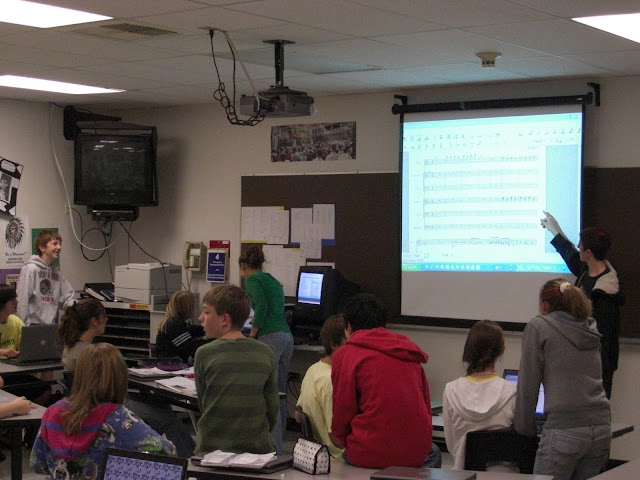
My students were quite excited to begin the process of composing a piece of music to fit a character. In period 2, we started talking about Lady Macbeth and her personality. What would we want to show in the song? We decided that we would show her in three stages from act one. We would show her elation at seeing her husband return home, her decision to not let King Duncan leave the castle by killing him so that Macbeth would become king, and finally her anger at Macbeth with his ambivalence about killing the king. We had some students who are as musically inclined as I am and so they worked on the lyrics (a.k.a. quotes) to fit with the music as well as finding visuals to support. The other kids, worked on the song. Amazingly, they all worked so well together testing sounds, putting together measure after measure, playing the notes, time and again. They decided the instruments that would best describe Lady Macbeth (flute) and how her tone would change into a French horn through her change in personality. Then they picked the instruments that would best accompany the sounds of Lady Macbeth. A few different kids took turns running the computer with other kids shouting up their thoughts. It seemed like organized chaos. One thing I must add here is how much I learned by watching and participating with them. I learned all sorts of vocabulary words about music (crescendo, decrescendo, staccato) and how to semi-compose music (you really have to pay attention to the notes you select with each instrument). But mostly, what I am hoping period two took away from today, and what they learned, is that music is a part of literature. When talking with them about the song, they asked my opinion about a particular part. I said it needs to sound like murder. Tristan responded that murder is an A and C sharp. And then another student, John, responding that we need to put in the key of death which is apparently E flat? As my department members were listening into our conversation they were enthralled with what these kids were doing. They were connecting Lady Macbeth�s descent into evil with music. You can hear the three distinct parts which they had mapped out at the beginning of class. It was amazing that I had kids come in on their off-hours to finish the song - and better yet, these were all boys! Boys that were asking to continue the learning. One even asked me at the end if we could do this for every book we read. Tomorrow we are going to play it for the class, make changes, and add the lyrics and visuals.
There's plenty more to read, including period 5's approach,
What was really interesting about the different approaches between my period 2 and period 5 is that it reflected how they have approached learning challenges in the class so far. Period 2 approached it collaboratively all working together, where period 5 broke into groups of music creators and lyrics composers.
examples of what they've created so far, a Picasa web album with pictures of them working,

and Anne will upload the final versions for each period once they're finished.

So, what have your students created today?

Tuesday, May 13, 2008

Poetry Out Loud (and read to yourself)

I meant to write this a couple of weeks ago right after National Poetry Month ended, but better late than never.

First, this story on NPR lets you hear Shawntay Henry, this year�s winner of the Poetry Out Loud contest, read �Frederick Douglass� by Robert E. Hayden.

Second, you can listen to the winners of AHS�s first iPoem contest. This was a last minute idea, so we didn�t get as much participation as we would�ve liked, but we�ll start earlier next year. First place, for the poem �Cthulu (pronounced ku-thew-lew) Converses with his Master� by Allie Fresch (Video, Text). First runner up, for the poem �Tekel� by Olyver Mycroft (Audio, Text), and second runner up for the poem �The Difference Between Life & Living� by Brittany Knigge (Audio, Text).

Finally, from the Summer 2008 issue of Mountain Rise, the International Journal of Scholarship of Learning and Teaching (published at Western Carolina University), the poem Teachers Must by Joe Mills, North Carolina School of the Arts.

Each fall when the new grapes arrive,
we sift and evaluate them,
trying to determine how best
to help them be what they can be.
Some are thin-skinned and delicate,
others gruff and independent.
Some need oak, others stainless steel.
No single process works for all,
so first we must identify
the grapes for what they are, not what
we wish they were. We also must
believe that careful attention,
time, and the right environment,
can help develop character,
complexity, balance, and depth.
But, most of all, we must have faith
that even when we can�t see them
fundamental transformations
bordering on miraculous
are bubbling under the surface.

Monday, March 31, 2008

VoiceThread Examples

We used VoiceThread for the first time just before spring break so I thought I�d share these examples. We still have a lot to learn about how to use it well, but I think these are a good start. Anne Smith describes several different poetry projects some of our freshmen completed - you should read the descriptions of the different types of poems as well as follow the links to some of the projects they created using various tools. Here are direct links to the VoiceThread examples in Anne and Maura Moritz�s classes:

Smith Period 2

Moritz Period 3

Moritz Period 4

Smith Period 5

As always, constructive criticism is welcomed, either on Anne�s post or � even better � leave a comment on some of the VoiceThreads.

Thursday, March 20, 2008

AWNM Wikified Research Papers

As the culmination of their study of A Whole New Mind, Anne Smith and Maura Moritz�s students had to complete a Wikified Research Paper. Here are links to the four wiki pages that have links to the students' wikis. (You�ll have to explore a little on each student�s wiki, some of them have their final paper on the home page of the wiki, others on a page titled Final Draft, and still others with various other page names .) There are over one hundred of these, so I certainly don�t expect anyone reading this to go read all of them (I certainly haven�t), but you might pick a couple from each class at random to read and then leave them some constructive feedback on the discussion tab of their wiki.

Smith Period 2

Moritz Period 3

Moritz Period 4

Smith Period 5

I wanted to take a moment to once again thank Daniel Pink and the folks in my network who helped us out with this project. Your participation, thoughts and insights are much appreciated.

Because a few folks asked, I also wanted to share a few of the technical details of the video conference with Daniel Pink. We brought all four classes together in our Forum (our large lecture-hall type classroom � the only one large enough for a group this size � around 110 students) for two hours (in-school field trip for the students). We connected with Mr. Pink via Skype. On our end we had a Dell computer that was connected to a large rear-projection screen that�s part of our Forum, as well as to speakers in the ceiling of the Forum. We used a Logitech Ultravision webcam (slightly newer version of it) for the video, and a Blue Snowball Microphone for the audio. On his end I believe he was using his Mac with the built-in iSight camera. He was also wearing headphones to minimize the audio feedback. (Skype appeared to do a great job with that � his wearing headphones helped us out, but we couldn�t use headphones on our end because all the students in the Forum needed to hear, but Mr. Pink reported very little audio feedback on his end.)

We had pre-selected twenty questions from students for Mr. Pink to respond to (they�re all in the live blog if you want to read through it), in addition to two general questions to get the ball rolling. Each student came down to the microphone to ask their question of Mr. Pink. After he answered, they could ask a follow-up or clarifying question if necessary. If they didn�t have one, then there were eight students down in front to carry on a very modified fishbowl discussion if they had anything to add to what Mr. Pink said (very modified fishbowl discussion because of the time constraints, having four classes in a lecture-hall setting, and the opportunity to hear from the author himself). The webcam and microphone were positioned to pick up the eight students down in front (as well as the students who came down to ask the questions), so Mr. Pink could hear those comments as well. The remaining students shared about thirty-five laptops and participated in live blogging using CoverItLive (I was on another Dell jockeying the CoverItLive blog).

Finally, we also ustreamed the whole thing (video archive, chat archive). We had a Canon camcorder hooked up via Firewire to a Mac and a second Blue Snowball Microphone positioned at the table with the eight students. I was at a table with a Dell (for the CoverItLive blog and with headphones to verify that the ustream was working) and the Mac (for the ustreaming itself).

Overall, the technology worked really well. The only real issue we had was that the ustream chat doesn�t always make it through our firewall, so I couldn�t monitor that, and we did lose the ustream a couple of times. Thankfully Kristin Hokanson captured the chat and helped me put the various orphaned ustreams back together so we have a pretty good record of the ustream.

Here are a few pictures to get a feel for what it looked like (especially for those of you who watched the ustream and perhaps thought there were only 8-10 students there).


Finally, I want to thank Anne, Maura and the students, for the incredible amount of time, effort and thought they put into this project. There are things we could�ve done better (and will do better next time we try something like this) but, overall, I think it was an amazing learning experience.

Thursday, January 17, 2008

Jose Has Some Questions

Jose is a ninth grader in one of Anne Smith's classes participating in the A Whole New Mind project. He's looking for some input regarding outsourcing, automation and abundance, so he decided to create a survey.

While I do have some questions about his questions - some are a little unclear to me - I thought that this was an excellent approach to gathering some data to help inform his thinking. Feel free to take the survey or leave a comment asking questions about his survey.

Tuesday, March 6, 2007

More Poetry Podcasts

Previously I blogged about Anne's classes posting podcasts of their poetry, and now Maura's classes have posted as well. Head over and take a listen to Period 1 or Period 6 and give them some constructive feedback.

Wednesday, February 28, 2007

Rhyme Time Podcasts

To update this earlier post, each student has now chosen the favorite poem that they've written and podcasted it. Please head over to this post on Learning and Laptops, listen to a few, and then give them some constructive criticism in the comments.

Friday, February 23, 2007

Rhyme Time

Over on Learning and Laptops, Maria � who is a ninth grader � wrote this:
Imagine: A place where students are adults and teachers are students. Imagine: A place where information is pulled, not fed. Imagine: A place where poetry can be real, deep, and fun at the same time.

Welcome to Ms. Smith's 9th Grade Honors English Class!!! Beware: This is NOT education as usual, please come prepared to learn in a way never experienced before. Please come excited to try new things, and to do your best, no matter the outcome.

. . . So boom! Out came student-taught poetry explications, publishing of our poems, and a opportunity that, instead of ogling Shakespeare's brilliance, we could to create our own! And our poems wouldn't simply be pieces of paper with a red grade, they would be published on the world-wide internet for others to enjoy and reply with their feedback.

The limits of blogging were pushed past the max as, each night from my computer at home, I would post the rough draft of one of my poems. Then I could scroll through all my classmates' poems, and discover new ideas and ways to improve. The next time I checked back, it was thrilling to read others' comments and feedback. It felt like a giant fishbowl, where instead of agonizing over a poem by myself, I could throw it out to a ton of different minds and we could build it up together, achieving an end result that I knew was truly my very best work.
If you go to the post, there are links to multiple examples on their blog. I particularly like this one.

Then, over on Anne Smith's ninth grade blog, the students in that class responded to this:
Students were asked to compose poems following the "I am" poem format revealing in one line who they truly are. This line is then repeated throughout the poem as they speak of their wishes, dreams, hopes and fears.
Students not only posted their poems as comments, but also commented on each other�s poems.

If you have a few moments, please check out the posts, read through some of the poems, and offer your constructive criticism in the comments.


Image Citation: Poetry and dreams, originally uploaded by Cher Amio.

Monday, February 19, 2007

Podcasting En Espa�ol - El D�a de San Valent�n y A.P.

We talked a little bit about podcasting with Cohort 2 last Tuesday. Jenny gets the award for quickest to implement a technology she just learned about � she started with her students that afternoon. This wasn�t a case of, �Ooh, cool new technology, let�s use it.� She had a purpose, and asked the students what they thought. Several volunteered, and now she has two sets of podcasts up.

In second and third year Spanish:
Students in 2nd and 3rd year Spanish classes wrote poems, odes, or letters to someone or something that they love and presented them in class on Valentine's Day.
And in A.P. Spanish: (also check out the AP Spanish blog )
When my class found out about this task last week, they were nervous to say the least. They had to read a paragraph, then listen to a minute long excerpt (all full of challenging vocabulary), and then present orally for two minutes comparing/contrasting/relating to the two sources. Here is the product of their first formal oral presentation.
This was their first attempt at this, so we�ll get better at the technical aspects. So, if you speak Spanish and have a moment, please stop by and give them some constructive criticism.